Good news! The exhibition “Brâncuși. The Syndrome” has been extended until 14 March 2027!
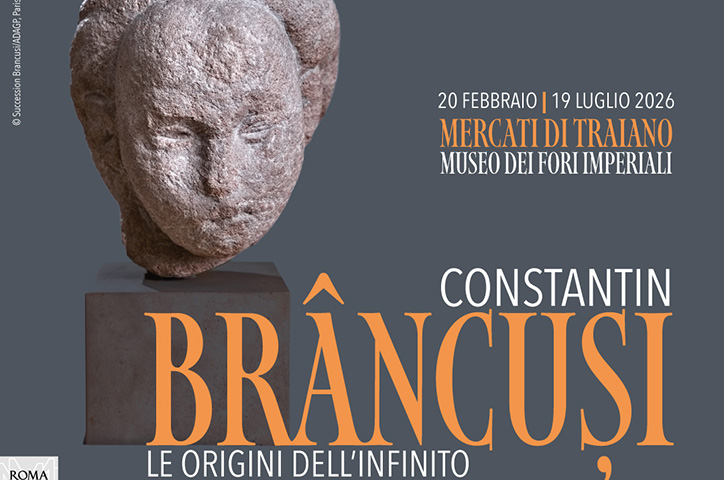
“Brâncuși. The Syndrome” marks the 150th anniversary of the birth of sculptor Constantin Brâncuși and offers visitors a distinctive perspective on the influence of his work. It examines the various forms of artistic discourse that have developed around the works and personality of the most important modern sculptor, from the interwar period to the present day. Two narrative strands, intertwined over the past century, can be understood as a veritable Brâncuși syndrome, which became endemic in Romanian culture. On the one hand, the exhibition reveals the formative dominant force exerted by Brâncuși’s personality and work on modern and contemporary Romanian art. On the other, it explores how Brâncuși’s mythical image took shape and spread throughout Romania’s visual culture, becoming a national, cultural and spiritual symbol.
The exhibition brings together works that trace both the artist’s image and the formal, symbolic and critical echoes of his artistic legacy. Among the works on display are portraits of Brâncuși by M.H. Maxy, Theodor Pallady and Milița Petrașcu; tributes created by M.H. Maxy and Vasile Dobrian; sculptures by Milița Petrașcu, Irina Codreanu, Hans Mattis-Teutsch, Ion Irimescu, George Apostu, Ovidiu Maitec and Vasile Gorduz; as well as contemporary interpretations and reappropriations of Brâncușian motifs. These range from Paul Neagu’s studies after “Bird in Space”, “The Fish”, “Mademoiselle Pogany”, “The Maiastra Bird” and “The Endless Column”, to works by Iosif Kiraly, Teodor Graur, Mircea Cantor, Vlad Nancă, Michele Bressan and Dan Perjovschi.
As Brâncuși achieved, particularly after 1970, global recognition as the “father of Romanian sculpture”, his presence became increasingly overwhelming. His name grew in prominence not only in the cultural sphere but also spread uncontrollably throughout public space. Miniature versions of the Endless Column, Table of Silence and Gate of the Kiss began appearing in all kinds of settings, stripping these key landmarks of their artistic legacy and meaning and triggering an invasion of kitsch. This phenomenon extended to the use of his best-known forms as decorations on an endless variety of products, from notebook or book covers to cigarette packets.
Starting with the 1990s, the phenomenon of Brâncușimania—unaffected and even intensified by the change of political regime—was documented, analysed and brought into question by artists such as Iosif Kiraly, Teodor Graur, Dan Perjovschi and Mircea Cantor. Curated by Judit Balint and Erwin Kessler, the exhibition “Brâncuși. The Syndrome” examines and juxtaposes these diverse discourses, both artistic and beyond the realm of art, that developed around Brâncuși’s name and work. It offers a complex picture of his influence on Romania’s social and cultural landscape and collective imagination.
The exhibition will be open to visitors from 12 June 2026 to 14 March 2027 at the National Museum of Art of Romania (MNAR) on the ground floor of the National Gallery.
Official Partner: Banca Transilvania
Exhibition organised with the support of The Friends of MNAR Association and the Romanian Cultural Institute.
Institutional Partners: Galați Museum of Visual Arts; “George Apostu” Cultural Centre, Bacău; “Vasile Pârvan” Museum, Bârlad; National Bank Museum; Constanța Art Museum; Mureș County Museum; National Museum of Contemporary Art (MNAC); and the National History Museum of Romania.